
Welcome!
We’re glad that you are here!
We accept everyone as they are. You are welcome to attend our Sunday services where you can learn about Buddhism, meet other Buddhists and join us for refreshments afterward.
What to expect during your first visit
We offer many different types of religious services at our temple, but the most commonly attended is our Sunday Dharma School Service, which is geared to families with school-age children and begins at 9:30 a.m. from mid-September to mid-June. An Adult Service is scheduled for 10:10 a.m. during the school year and 10 a.m. during the summer. Below is an outline of the format that these Sunday services typically follow. All of our public services are live streamed and can be watched on our Youtube channel. (You can also watch the most recent services here.)
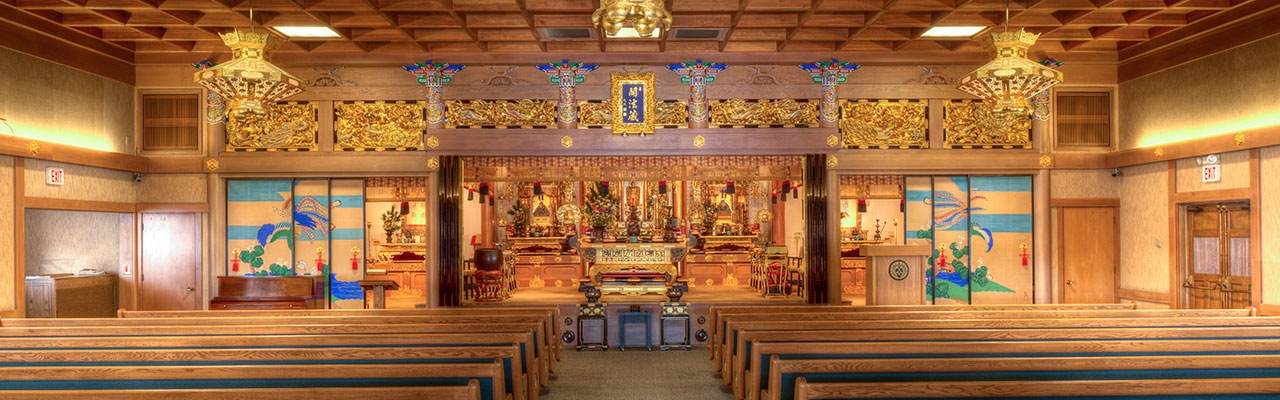
What is the Hondo?
The Hondo is the main hall of the temple where services take place. (Pictured above) When we enter this room, it is customary to bow at the doorway, a mindful reminder that we are entering a place of peace and respect. Before exiting, you should turn, face the altar, and bow again to show mindfulness and appreciation.
We ask that you refrain from eating, drinking (water, in closed containers is permissible), using your cell phone, and talking during the service. We recommend putting any phones on silent or “Do Not Disturb” mode so that you can remain fully present for the hour!
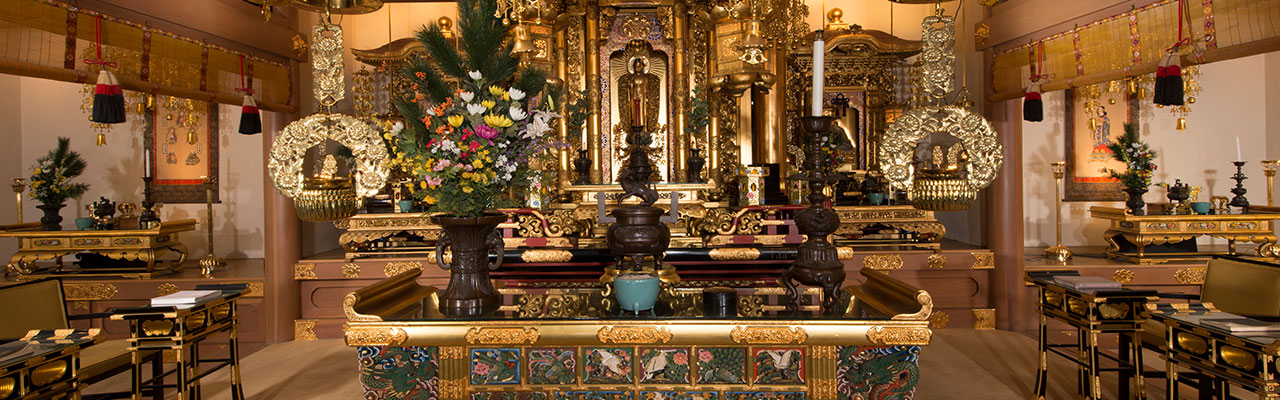
It is also respectful to bow if you ever cross in front of the Amida Buddha which is the central figure on the altar.
Japanese Language Service
The second Sunday of the month we have a service in Japanese immediately following the adult service, usually beginning at about 11 a.m.
毎月第2日曜日には、大人向けの礼拝の直後に日本語の礼拝を行っています。この礼拝は通常、午前11時頃に始まります。
Program for a Typical Service
Ringing of the Bell
The traditional ringing of the bell (“Kansho”; both the bell and the act of ringing this bell is called “kansho”) located on the veranda of the temple signals the start of the service. The attendees quiet down in silent meditation.
Ministers walk to their seats
At most services, the ministers and minister’s assistants will sit in front of the altar, facing forward. For special services, the ministers will sit in the altar area, facing each other.
Chairperson
The chairperson welcomes everyone and announces the hymns (“gathas”) and the chantings (“sutras”) for the service, including the pages. The page numbers of the hymns, chants and readings will also be shown on a large monitor at the front of the altar. Unlike some other Buddhist traditions, except for sections that are read only by the leader that are designated with an asterisk ‘*’ or a pound ‘#’, everyone are welcomed to chant. There may be different number of hymns and readings based on the service.
Sutra chanting
Ministers will lead the chanting. The sutras are the words of the historical Buddha or influential Buddhist teachers. The chants are all written in romanized form. (i.e. English alphabet).
Reading
The Reading is a text that accentuates a central Buddhist concept. Most common in the Dharma School Service is the “Golden Chain” while in the Adult Service it is the “Three Treasures” which is read by almost all Buddhists traditions.
Dharma Talk
The Dharma is the Buddhist teachings and are passed down from the historical Buddha and through the founder of our sect, Shinran Shonin. The Dharma talks are given by ministers and our minister assistants in English.
Closing Gatha
Most of the songs are in English. Others are in Japanese. Most common song is “Sayonara”(goodbye) and “Farewell” in the Dharma School Service and “Ondokusan II”(profound gratitude) in the Adult Service.
Announcements
Events and activities are announced by representatives of various temple organizations.
Incense Offering
Everyone is invited to walk toward the metal burners and offer incense. There are usually two lines that form down the middle aisle of the temple. See the “How to Oshoko” section below for the preferred way of offering incense. Students then leave the temple to attend Dharma School classes located in various rooms of the Betsuin.
Refreshments
After the end of the adult service and Dharma School classes(usually about 11 a.m.), everyone is invited for refreshments in the multi-purpose room of the gym building (located on the opposite side of the garden) or in the garden during the summer months.
Practices and Traditions
If you’ve been wondering how to offer incense or where we gather for service you’re in the right place!
In the following text, you’ll find walkthroughs, how-to’s, and explanations of common service practices and traditions that you might observe during your visit.
How to Oshoko (Incense Offering)
The literal translation of Oshoko is “burning incense”, but we often use this word to represent the act of offering incense. Many practices in Jodo Shinshu Buddhism are exercises in being mindful.
- First step within 2 ~ 3 steps of the burner. Bow.
- Take 2 ~ 3 steps up to the burner starting from the left foot. (closer to your heart).
- Take a small pinch (2 or 3 grains) of incense and put it on the charcoal burner.
- Put your hands together and bow. This gesture is called the “gassho”.
- Step back 2 ~ 3 steps OR step to the side (this depends on the number of people; if a line of people behind you, step to the side. Just follow what others are doing ahead of you)
- Bow (simple bow, not a “gassho”)
You can also view this video below (courtesy of Gardena Buddhist Church). Warning: they describe things down to pretty minute detail. We are nowhere as strict. Anything you do is fine.
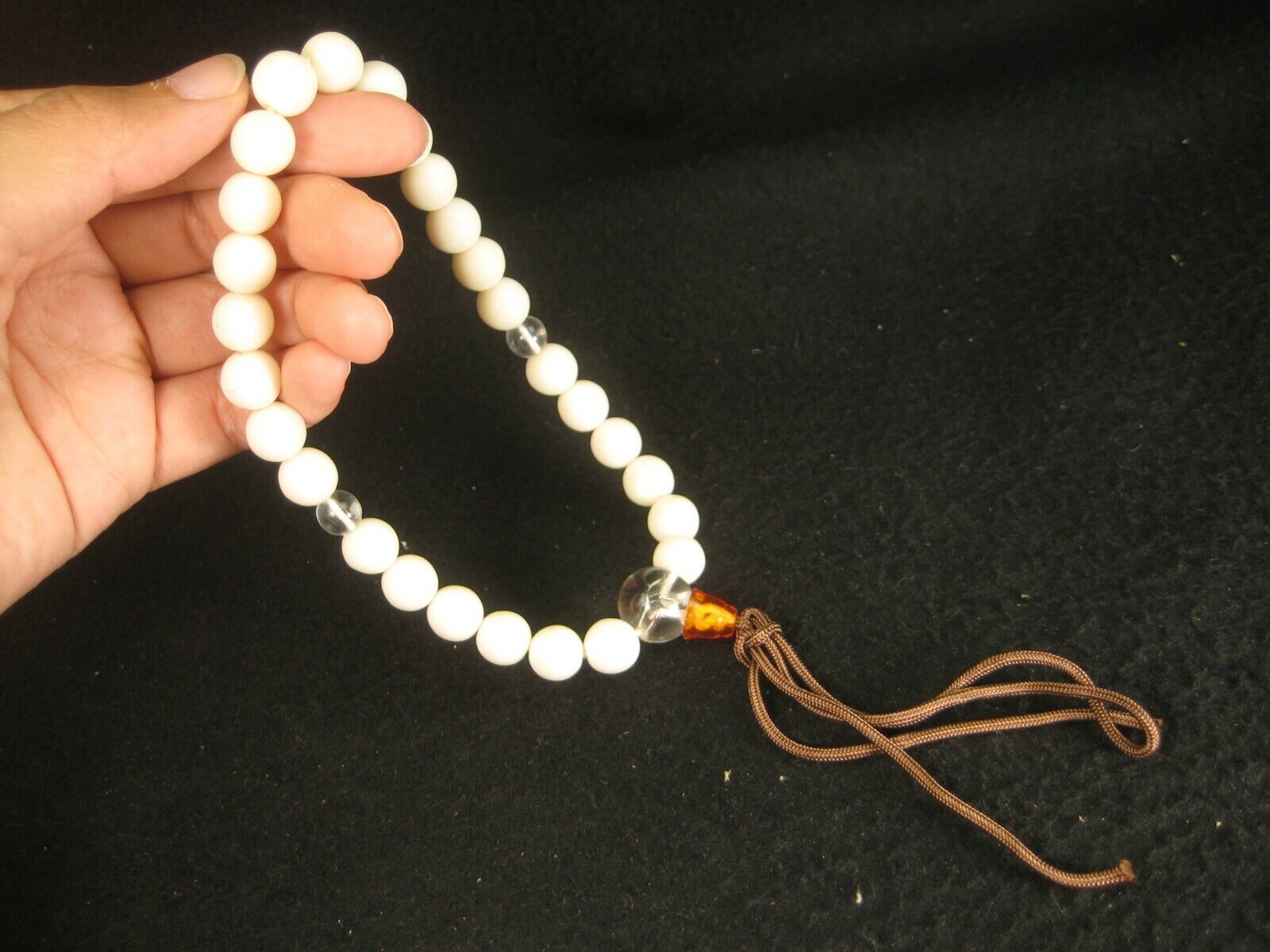
What is an Onenju?
The Onenju, or Ojuzu as some people refer to them, literally means prayer beads and were originally used as counting beads. (In fact, o-nenju 念珠 means “prayer beads” and ojuzu 数珠 means “counting beads”) Their origin is lost to history and it is unclear if they originated with Buddhists or some other Indian religious tradition. In our Jodo Shinshu tradition, they are a symbol of the 108 blind passions that influence our lives during a calendar year. The long onenju that our ministers have 108 beads to denote this. Most of the other onenju have some factor of 108 beads. There is a larger bead where the knot resides and that is considered the “Buddha” bead. There may be two other different colored or sized beads; these are called the “Parent” beads. The string serve as a symbol of the interdependence of all beings. The Onenju serves as a way to be mindful of these passions as we put our hands together in Gassho (literal meaning is “palms together”).
Temple Etiquette FAQs
- What should I wear to a service?
At our services, you’ll see some members in their Sunday best, and some in more casual outfits, like a sweater and jeans. Is there anything I need to bring? For your first visits, you only need to bring yourself! If you have prayer beads (Onenju), you are welcome to bring those to use throughout the service, but they are not required.
- Do I have to make a donation to attend?
All Sunday services are free and open to the public. Donations are always appreciated, but not required to attend! If you would like to make a monetary donation at the service, there is a black wooden donation box (Osaisen-bako) as you enter the Hondo (main hall) and baskets beside each incense burner in front of the altar. Donations can also be dropped off at our Office. All service donations (Osaisen) go to support the activities of our temple.
- Can I bring my children?
Yes! Our services and temple community are very family-friendly. There are times during service when we do ask that the Sangha (congregation) quiet all personal conversations. Our 9:30am Dharma School Services are followed by Dharma School (Sunday School for K-12th Graders). If you are interested in enrolling your children, please visit our Dharma School page to learn more!
- How do I respectfully observe a service if I am not Buddhist?
Whether or not you are Buddhist, here are a few helpful tips for visitors:
-
- We respectfully ask that everyone silence their cell phone when entering the Main Temple
- At the entrance to the Hondo, it is customary to bow toward the Main Altar (Onaijin), both when entering and leaving.
- You can sit anywhere you like and can find a seat by using the aisles on the outside of the pews (as opposed to the center aisle).
- Listen attentively to the Dharma message, sing along with the Gathas, and participate in the chanting if you’re comfortable! Your experience will be richer from it.
- After service, please plan to join us for coffee and snacks, either outdoors in the garden or inside our Annex building, depending on the weather. It’s always a wonderful time to meet people, share your experience, and ask questions!
- Is any of the service conducted in English? Will I need to learn Japanese to participate in the service?
Almost all the service is conducted in English! Only a small minority of the members read Japanese. There is Japanese in some of our texts, but they are accompanied by the romanization (in English letters) and often by the translations. The only services where Japanese is spoken are the Monthly Japanese Service and the major holiday services where the ministers might give a portion of their Dharma Talk (sermons) in Japanese.